Emotional Intelligence Tests: How Do You Measure EQ

Emotional Intelligence (EQ) has become one of the most important predictors of leadership success, workplace harmony, and personal fulfillment. But if you’re asking yourself, “How do I actually measure emotional intelligence?” you’re not alone. Fortunately, there are several emotional intelligence tests designed to assess your ability to recognize, understand, and manage emotions—both your own and others’.
In this guide, we’ll break down what EQ really is, explore how it can be measured, and introduce some of the most widely used emotional intelligence assessments that organizations and individuals rely on today.
What is EQ (Emotional Intelligence)?
EQ, or Emotional Intelligence, is the ability to identify, interpret, and manage emotions effectively. Coined by psychologist Daniel Goleman, emotional intelligence goes beyond IQ, measuring how well you navigate interpersonal relationships, regulate stress, and respond empathetically.
At Positive Leader, we emphasize EQ because it underpins effective communication, leadership, conflict resolution, and team dynamics—skills crucial in today’s ever-evolving workplaces.
Can Emotional Intelligence Be Measured?
Yes. Psychologists have developed scientifically validated tools to measure EQ through self-report questionnaires, ability-based tests, and behavioral assessments.
These tests typically evaluate dimensions such as self-awareness, self-regulation, empathy, motivation, and social skills. The results can be eye-opening, providing insight into personal strengths and areas for development, especially in professional settings like hiring, team-building, and leadership development.
Characteristics of High EQ and How They Are Measured
EQ isn’t just one thing—it’s a mix of traits like self-awareness, empathy, and social skills. The good news? There are plenty of popular tests out there, like MSCEIT and Genos (not to mention our own PAT℠), that help measure how you stack up in each area. Let’s break them down one by one.
1. Self-Awareness
In a professional setting, high self-awareness isn’t just about ‘feeling’ your emotions, it’s about understanding their impact on your decision-making. Leaders with high self-awareness are often the first to admit when they don’t have all the answers. They recognize their personal triggers (such as stress from a tight deadline or frustration with a complex project) and they take proactive steps to ensure these emotions don’t derail team morale. This transparency builds immense trust within teams.
Self-awareness refers to your ability to recognize your emotions as they arise. Tests typically measure this by asking how well you can identify emotional triggers and how your mood influences your decisions.
Popular Tests:
- EQ-i 2.0 Self-Perception Composite: This section of the EQ-i 2.0 measures self-regard, self-actualization, and emotional self-awareness through self-report items.
- DiSC Personality Assessment: While primarily a personality assessment, DiSC helps participants become more aware of their behavioral tendencies and emotional triggers.
- 360-Degree Feedback Surveys: Collects feedback from peers, managers, and subordinates to help individuals gain insight into how others perceive their emotional awareness and leadership style.
2. Self-Regulation
Self-regulation is the buffer between a feeling and an action. For a leader, this manifests during high-stakes meetings or intense negotiations. Rather than reacting impulsively when faced with negative feedback or a sudden project failure, a self-regulated leader pauses to process the information. This creates the psychological safety needed for team members to speak up without fear of an immediate, emotional backlash.
Self-regulation is your capacity to manage disruptive emotions and impulses. Tests evaluate this through scenarios that require staying calm under pressure, controlling anger, or managing stress effectively.
Popular Tests:
- MSCEIT (Mayer-Salovey-Caruso Emotional Intelligence Test): Specifically evaluates how well individuals can manage emotions and apply emotional reasoning in stressful situations.
- The Hogan Development Survey (HDS): Assesses derailers, or tendencies that may emerge under stress and affect self-regulation.
- The Resilience Scale (RS-14): While not strictly an EQ test, this scale measures resilience and adaptability—key components of self-regulation.
3. Empathy
Empathy in the workplace is often mistaken for merely being ‘nice,’ but it is actually a strategic skill. It involves active listening—not just hearing words, but reading the underlying concerns or motivations behind them. An empathetic leader can sense when a team member is overwhelmed before it impacts their productivity. By acknowledging these challenges, leaders can provide the right support, which directly correlates to higher employee retention and engagement.
Empathy is often measured through emotional recognition tasks and questions about interpersonal sensitivity.
Popular Tests:
- Reading the Mind in the Eyes Test (RMET): Measures how well a person can interpret emotions from facial expressions.
- Interpersonal Reactivity Index (IRI): A widely used tool to assess empathetic concern and perspective-taking.
- Genos Emotional Intelligence Inventory: Has a dedicated focus on empathy and emotional awareness in workplace settings, measured via behavioral feedback.
4. Motivation
Motivation for high-EQ individuals is rarely just about a paycheck or a title. It’s an internal drive, a commitment to a vision, a purpose, or the growth of their team. This intrinsic motivation is what allows leaders to remain resilient when goals seem unreachable. They are able to sustain energy and optimism throughout long-term projects, which acts as a beacon for the rest of the team during difficult periods.
High-EQ individuals display internal motivation that is not solely dependent on external rewards. Motivation is usually assessed by how well you can set personal goals, persevere through challenges, and maintain a positive attitude.
Popular Tests:
- StrengthsFinder (CliftonStrengths): Identifies internal motivators and strengths that can be tied to intrinsic motivation.
- Work Extrinsic and Intrinsic Motivation Scale (WEIMS): Measures internal and external drivers for motivation, providing insight into what pushes individuals to act.
- Bar-On EQ-i (General Mood Component): Assesses optimism and happiness as key indicators of emotional self-motivation.
5. Social Skills
Social skills are the outward expression of EQ. They are the tools leaders use to build networks, resolve conflicts, and influence outcomes without resorting to authority or coercion. A high-EQ leader uses these skills to bring different personalities together, ensuring that varied viewpoints are heard and integrated. They are effective at navigating organizational politics by keeping the focus on shared goals rather than personal agendas.
Social skills, including effective communication and conflict resolution, are assessed through behavioral questions or scenario-based exercises that examine how well you collaborate and influence others.
Popular Tests:
- Thomas-Kilmann Conflict Mode Instrument (TKI): Evaluates how people approach conflict and collaboration.
- Social Skills Inventory (SSI): A comprehensive tool that assesses verbal and non-verbal communication skills, emotional expressivity, and social control.
- Positive Assessment Tool (PAT℠): Evaluates interpersonal skills and leadership communication styles, specifically within professional environments.
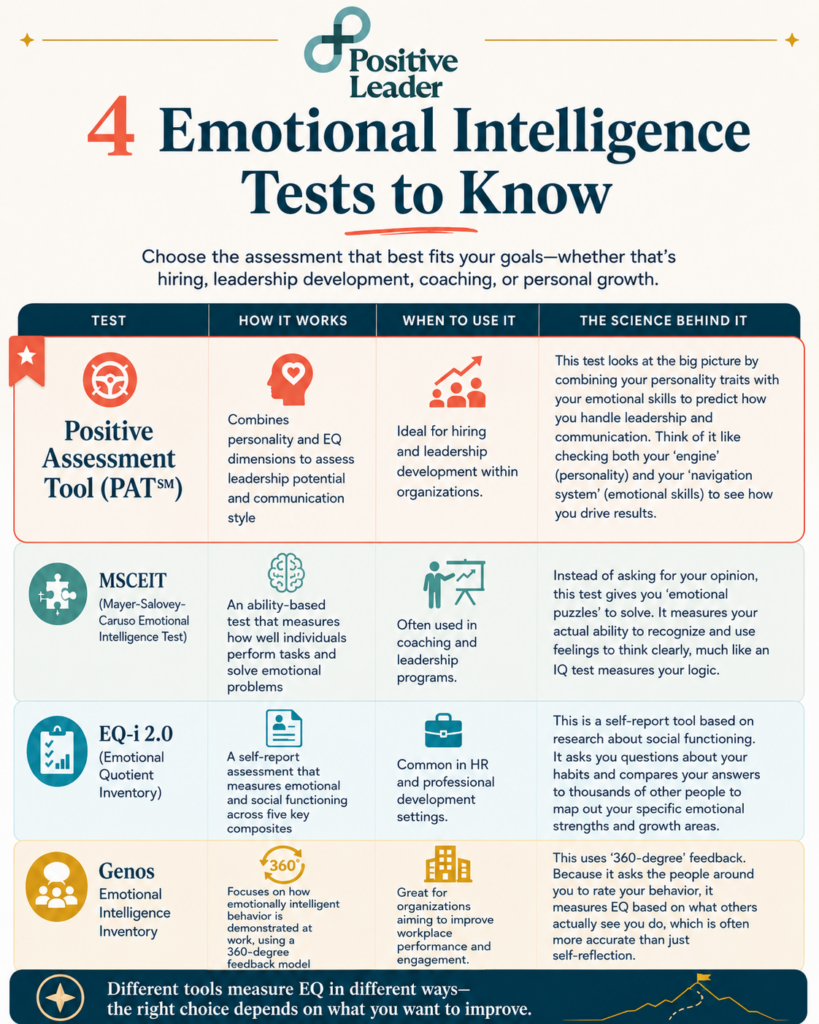
4 Emotional Intelligence Tests to Know
When choosing an emotional intelligence test, it’s important to select one that matches your goals, whether it’s for leadership development, hiring decisions, or personal growth. Below are four popular options:
| Name of Emotional Intelligence Test | How it works | When to use it | The Science Behind It |
| Positive Assessment Tool (PAT℠) | Combines personality and EQ dimensions to assess leadership potential and communication style | Ideal for hiring and leadership development within organizations. | This test looks at the big picture by combining your personality traits with your emotional skills to predict how you handle leadership and communication. Think of it like checking both your “engine” (personality) and your “navigation system” (emotional skills) to see how you drive results. |
| MSCEIT (Mayer-Salovey-Caruso Emotional Intelligence Test) | An ability-based test that measures how well individuals perform tasks and solve emotional problems | Often used in coaching and leadership programs. | Instead of asking for your opinion, this test gives you “emotional puzzles” to solve. It measures your actual ability to recognize and use feelings to think clearly, much like an IQ test measures your logic. |
| EQ-i 2.0 (Emotional Quotient Inventory) | A self-report assessment that measures emotional and social functioning across five key composites | Common in HR and professional development settings. | This is a self-report tool based on research about social functioning. It asks you questions about your habits and compares your answers to thousands of other people to map out your specific emotional strengths and growth areas. |
| Genos Emotional Intelligence Inventory | Focuses on how emotionally intelligent behavior is demonstrated at work, using a 360-degree feedback model | Great for organizations aiming to improve workplace performance and engagement. | This uses “360-degree” feedback. Because it asks the people around you to rate your behavior, it measures EQ based on what others actually see you do, which is often more accurate than just self-reflection. |
Positive Assessment Tool (PAT℠)
The Positive Assessment Tool (PAT℠) is Positive Leader’s proprietary assessment tool, designed to evaluate both personality and emotional intelligence traits. It provides actionable insights into leadership capabilities, communication preferences, and potential blind spots. It’s particularly effective for companies looking to hire or develop leaders with high EQ.
MSCEIT
This is an ability-based test that evaluates how well you process emotional information and apply it to reasoning and decision-making. Instead of self-reporting, it measures your ability to perceive, use, understand, and manage emotions.
EQ-i 2.0
One of the most widely used emotional intelligence assessments, the EQ-i 2.0 offers a detailed report on emotional and social functioning. It’s beneficial for individuals seeking self-awareness or organizations conducting leadership development programs.
Genos Emotional Intelligence Inventory
Genos uses behavioral feedback to assess how well participants demonstrate emotionally intelligent behaviors at work. Its 360-degree model makes it useful for fostering team development and improving workplace culture.
Why Measuring EQ Matters
Understanding and improving emotional intelligence can lead to stronger leadership, better teamwork, and a healthier workplace culture. By measuring EQ, businesses can make more informed hiring decisions, foster high-performing teams, and support professional development initiatives.
At Positive Leader, we believe that a combination of self-awareness and actionable insights is the key to building resilient, empathetic, and highly effective leaders.
For further reading, see our post on 8 Signs of Low Emotional Intelligence.
Ready to Start Measuring EQ in Your Organization?
Learn how our Positive Assessment Tool (PAT℠) can help you assess EQ and leadership potential during your hiring or talent development process.
Contact us about the PAT for hiring today