7 Bad Management Styles That Sabotage Success – and How to Eliminate Them

Few things drain an organization faster than an ineffective manager. We’ve all been there — either working for one, or, if we’re honest, catching ourselves being one. Bad management isn’t always loud or obvious. Sometimes it’s subtle: a passive-aggressive comment in a meeting, a failure to give credit, or a reflexive “we’ve always done it this way” when someone proposes a better path.
The cost is staggering. According to Gallup, disengaged employees cost U.S. companies between $450 billion and $550 billion annually, and poor management is one of the leading drivers. (Source: Gallup State of the American Workplace) And it’s not just a morale issue. 57% of employees have left at least one job because of a bad manager, and 84% of U.S. workers say poorly trained managers create unnecessary stress and extra work. That’s a talent and productivity crisis hiding in plain sight.
The good news? Most of these management styles are learned behaviors which means they can be unlearned. Whether you’re a senior executive, a first-time team lead, or somewhere in between, recognizing these patterns is the first step. Understanding your leadership strengths and weaknesses is what separates good managers from great ones.
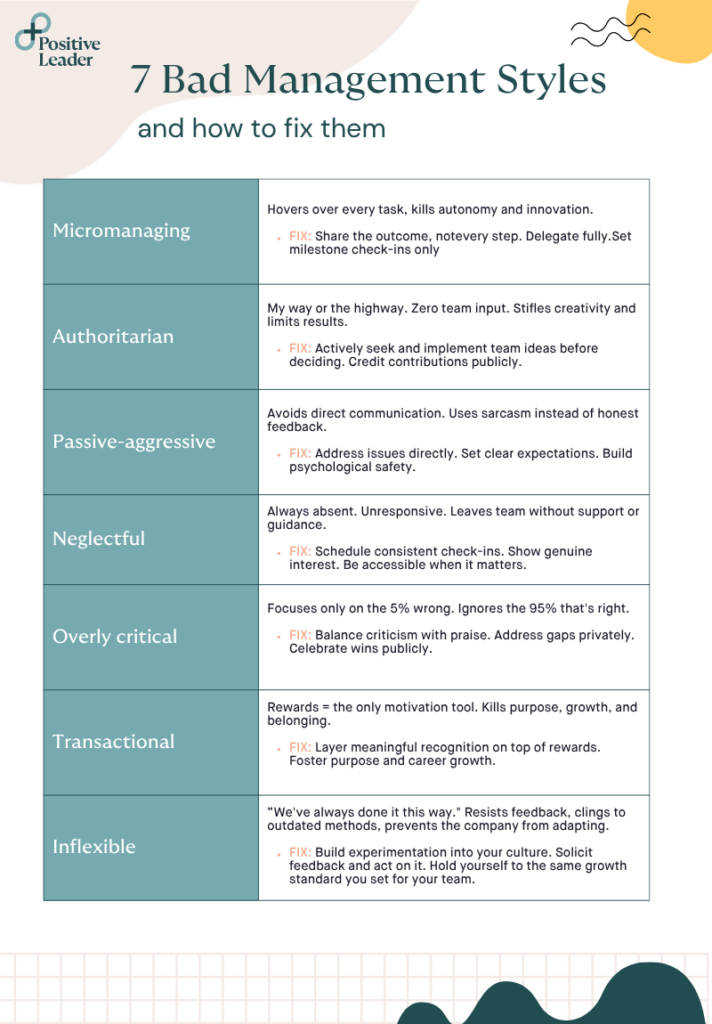
1. Micromanaging
We’ve all been there: either enduring it or guiltily doing it. The micromanager hovers. They monitor every keystroke, demand updates on tasks they didn’t assign, and can’t resist rewriting work that was already good enough.
Imagine you’ve just finished drafting the copy for a new product launch page. Before you can even do a self-edit, your manager is reading over your shoulder, flagging commas and second-guessing word choices you would have caught yourself. The result? You stop trying as hard, because the work will be redone anyway.
Micromanagement signals a trust deficit and it creates a self-fulfilling prophecy. When employees aren’t allowed to own their work, they become less capable, less confident, and less invested. Innovation dies quietly. Turnover rises loudly.
The fix: Share the outcome you need and let your team decide how to get there. Establish check-ins at logical milestones — not daily status updates on every task. If you struggle with delegation, you’re not alone. Our post on delegative leadership offers a practical roadmap for letting go without losing control.
2. Authoritarian Leadership
“My way or the highway.” It’s a management philosophy that gets results — until it suddenly, catastrophically, doesn’t.
Authoritarian managers make decisions unilaterally. Brainstorming sessions are theater: the manager has already decided, and the “discussion” is just waiting for everyone else to agree. There’s rarely space for dissenting ideas and if those ideas are raised, they’re dismissed.
History gives us cautionary tales here. While leaders like Catherine the Great wielded authority effectively through decisive action, even she understood the power of drawing on advisors and incorporating diverse perspectives. The modern workplace demands even more: employees today expect their voices to be heard, and they’ll vote with their feet when they’re not.
Authoritarian leadership stifles creativity, tanks morale, and limits results to whatever one person knows instead of what an entire team could achieve together. It also tends to correlate with low emotional intelligence, which compounds the problem.
The fix: Actively solicit input before decisions are made and mean it. Implement ideas that come from your team and credit them publicly. Your job is to harness the collective intelligence of your group, not replace it.
3. Passive-Aggressive Leadership
This one is sneaky. Passive-aggressive managers rarely say what they mean. Instead, displeasure surfaces as sarcasm, cold shoulders, or pointed “jokes” in team meetings.
Miss a deadline? Don’t expect a direct conversation. Expect a comment in the next all-hands meeting: “Well, I guess we’re all working on our own timelines now.” Everyone knows it’s directed at someone. No one learns how to do better.
Passive aggression erodes psychological safety. When employees don’t know where they stand, they become anxious, guarded, and less willing to take the creative risks that drive growth. Teams led this way tend to have higher conflict and lower trust.
The fix: Say what you mean, clearly and kindly. Address issues directly and constructively, as they arise. Create an environment where people can come to you with concerns without fear of passive retaliation. Directness isn’t harshness — it’s respect.
4. Neglectful Leadership
On the opposite end of the micromanagement spectrum is the ghost manager. They’re never available. Emails go unanswered for days. During a critical product launch, they’re somehow always “in another meeting.” Employees are left to guess, assume, and navigate challenges without a compass.
Neglectful management is particularly damaging because it’s often invisible. Unlike the micromanager who creates visible friction, the neglectful manager creates a vacuum and vacuums get filled with confusion, mistakes, and low morale. Why should your team go above and beyond if leadership doesn’t bother to show up?
This style also sends a dangerous message: your work doesn’t matter enough for my attention. Over time, that leads to exactly the disengagement you’d expect and the kind of turnover that quietly costs companies far more than most realize.
The fix: Put recurring check-ins on the calendar, not excessive ones, but consistent ones. Be present, responsive, and show genuine interest in how your team is progressing. Accessibility isn’t a soft skill; it’s a leadership requirement.
5. Overly Critical Management
Getting 95% of everything right should feel good. But when your manager only talks about the 5% you got wrong, 95% starts to feel meaningless.
Overly critical managers forget that praise is not a luxury; it’s a performance tool. When a team member’s presentation goes well but their slide design needs work, the critical manager leads with the design issues, hashes out what went wrong, and wraps up without a single acknowledgment of what landed. The team member walks out deflated rather than empowered to improve.
This management style is one of the fastest ways to destroy psychological safety and stifle professional growth. It also tends to create a poor company culture that spreads well beyond the immediate team.
The fix: Practice the balance. For every piece of critical feedback, pair it with genuine recognition of what’s working. Address specific performance concerns privately, with actionable steps — not in front of the team. Explore the 5 Languages of Appreciation to understand how different team members prefer to receive recognition, and speak their language.
6. Transactional Management
Rewarding results isn’t wrong. It becomes a problem when it’s the only tool in your kit.
Transactional managers run their teams like a vending machine: input effort, receive reward. Bonuses for hitting targets. Gift cards for good quarters. But when the bonus structure doesn’t apply? Motivation drops. Because you’ve accidentally trained your team to work for rewards, not for meaning.
The research on intrinsic vs. extrinsic motivation is clear: while extrinsic rewards can boost short-term performance, they often undermine long-term engagement and creative thinking. People want to feel that their work matters — that they’re growing, contributing, and part of something worth caring about.
The fix: Layer meaningful recognition on top of (not instead of) tangible rewards. Acknowledge creative problem-solving. Celebrate learning from failure. Create pathways for growth that aren’t tied to a bonus. When employees feel a sense of purpose, discretionary effort follows naturally.
7. Inflexible Leadership
“We’ve always done it this way.” Six words that have quietly killed more innovation than any competitor ever could.
Inflexible managers aren’t necessarily bad people — they’re often experienced ones who’ve found what works and see little reason to risk it. But clinging to outdated processes in a world that changes by the quarter is a slow fade to irrelevance. The inflexible manager resists new tools, dismisses feedback, and frames adaptability as instability.
Consider how leaders like Bill Gates consistently evolved their approach — pivoting from software developer to business strategist to global philanthropist. You can read more about how adaptability defined his leadership style here. Rigidity didn’t build Microsoft — curiosity and willingness to change did.
The fix: Build experimentation into your team culture. Try new approaches on a small scale. Actively solicit feedback about what’s working and what isn’t — and act on what you hear. Fostering accountable leadership means holding yourself to the same growth standard you hold your team to.
How to Identify Your Management Style and Start Improving It
Here’s the thing: most managers don’t choose these styles. They fall into them — often under pressure, or because it’s all they’ve seen modeled. Awareness is everything.
Self-assessment is where real change begins. Tools like 360-degree feedback and personality-based leadership assessments help managers move from vague self-perception to concrete, actionable insight. Understanding how you’re wired — and how your team experiences your leadership — changes everything.
Positive Leader’s Positive Assessment Tool (PAT℠) is built for exactly this. It helps leaders identify their natural behavioral tendencies, communication style, and areas of untapped potential — so you can stop guessing and start growing. Used by individuals and organizations alike, it’s one of the most direct paths from recognizing a bad management habit to replacing it with something that actually works.
Ready to Lead Differently?
If you’ve recognized yourself in one (or more) of these styles, that self-awareness is already a win. The next step is doing something with it.
👉 Take the Positive Assessment Tool (PAT℠) to uncover your leadership strengths, pinpoint growth areas, and get a clear picture of how your style impacts your team. Whether you’re an individual looking to grow or an organization looking to develop leaders at scale, Positive Leader has a solution for you.
Explore our solutions for teams and organizations, or contact us to find the right fit for your situation.